HR-CRO - Croatia
 BrelaBluesun Hotel Soline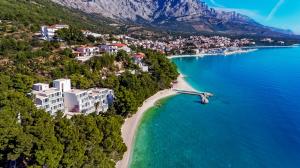
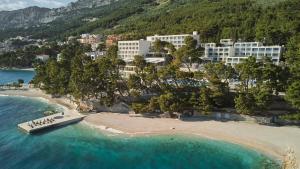

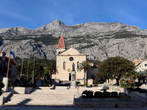
Baska Voda - St. Nicholas Church

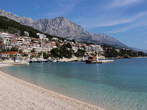




Baska Voda is a charming tourist town and port in Split-Dalmatia County, situated on the northwestern part of the Makarska coast, at the foot of the Biokovo mountain range, about 10 kilometers from the picturesque town of Makarska. The region enjoys a pleasant Mediterranean climate, with many sunny days throughout the year.
Tourism is the primary economic activity in Baska Voda, with its greatest development occurring after World War II. Prior to that, the local economy was based on fishing and agriculture, though only a few residents actively engaged in these trades. The area’s first hotel, Hotel Slavija, was built in the early 1930s, marking the beginning of Baska Voda’s transformation into a tourist destination.
The town features a small port, protected by a long breakwater with a lighthouse at its end, along with two small piers. Archaeological discoveries show that the area was inhabited during Roman times, with some of the richest finds located on and around Gradina hill. These include graves containing ashes, jewelry, lamps, coins, and other artifacts.
In ancient times, the nearby village of Bast grew around a fresh water spring that provided for the Biokovo region. After the Turks were expelled in the early 18th century, the inhabitants moved from the slopes to the coast, founding what is now Baska Voda, today a thriving tourist center.
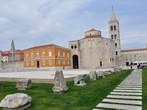
Among the town’s historical landmarks are two baroque churches: the Church of St. Lawrence, built in 1750, and the Parish Church of St. Nicholas, constructed in 1889. The Church of St. Nicholas, dedicated to the patron saint of sailors and travelers, is a neo-Romanesque structure and a protected cultural monument. Its stained glass windows were created by renowned artist Josip Botteri Dini in 1987, while the Stations of the Cross, completed in 1988, are the work of Croatian painter Josip Biffle. The baptistery, added in 1994, was designed by artist Veno Jerkovic. Surrounding the church are medieval tombstones, adding to its historical significance.
One of Baska Voda’s cultural landmarks is the Fountain Source, dedicated to the hardworking local women who played a crucial role in the town’s history. Created by artists Ozren Filipovic and Robert Jozic, the fountain is located near one of the original freshwater springs that gave the town its name.
Photos
Photo: 40520010-0
St. Nicholas Church

Photo: 40520010-1
Baska Voda - St. Nicholas Church

Photo: 40520010-2
Information board - St. Nicholas Church

Photo: 40520010-3
Front

Photo: 40520010-4
St. Nicholas Church - Entrance

Photo: 40520010-5
St. Nicholas Church - Interior

Photo: 40520010-6
Interior of the church in Baska Voda

Photo: 40520010-7
Interior - North side

Photo: 40520010-8
Interior - South side

Photo: 40520010-9
St. Nicholas Church - Church tower

Photo: 40520010-10
Parish Office