Reka is the third largest city in Croatia, after Split and Zagreb, and the main sea port. It is located at the mouth of the Rijecina River on the northern coast of the Kvarner Gulf. It is the seat and capital of the Primorje-Gorski Kotar County.
The Gulf of Reka is bounded by Mala Vrata, Vela Vrata and Srednja Vrata and is connected to the Kvarner Gulf. The bay is deep enough, about fifty meters, to accommodate large merchant ships. The river is surrounded by mountains on three sides. Ucka stands out in the western part. To the east is the Velika Kapela mountain range. To the northeast lies the Risnjak massif with the national park and the Sneznik plateau. The city lies on a long and narrow strip along the coast. Reka has a rich historical past. The Liburnian fort on the hill above the left bank of the Rjecina River, the current Trsat, is considered the most convenient settlement in the Reka area. The old city center is located on the right bank of the Rjecina. Underneath the streets of the city are archaeological remains and a network of old tunnels. The city center is surrounded from the southern part by Korza, which represents the center of the Reka. It is the venue for public events and the city's most famous street. In the middle of Korzo is a town tower with a clock, which is a meeting place for locals and tourists.
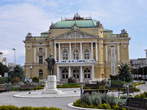
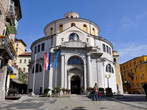
The city's economy is mostly dependent on shipbuilding and maritime transport. HNK Rijeka is a city football club that plays at the Kantrida Stadium. Reka Airport is located on the island of Krk and was built in 1970. The biggest cultural and historical attractions are the Cathedral of Saint Vid, the patron saint of the city, the Church of the Assumption of Mary, the ancient city gates, the building of the Maritime and Historical Museum of the Croatian Primorje, the former Renaissance Governor's Palace, the Croatian National Theater Ivan pl. Zajca, Modello Palace, the Great Market, Trsat Castle and the Church of Our Lady of Trsat. The city boasts a historical, natural history and maritime museum as well as a modern gallery. Reka has a humid subtropical climate, with rainy and mild winters and warm summers. Cold winds are common in winter. Snow is very rare. Unlike most Mediterranean places, there is no summer drought in the city. Locals and tourists enjoy the beaches all summer in a typical Mediterranean environment along the coastal areas of the city in the west (Preluk, Kantrida) and east (Kostrena, Pecine).
In the pre-holiday period, the town hosts the Reka Carnival, which is considered the largest event of its kind in Croatia. It is also one of the largest and most visited in Europe. In 2020, Reka, together with the Irish city of Galway, was chosen as the European Capital of Culture.
 HR-CRO - Croatia
 RijekaMolo Longo - Downtown Apartments