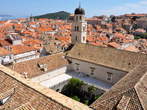
The Franciscan Monastery in Dubrovnik is located in the heart of the old town, near Stradun, the city’s main street that connects many of Dubrovnik’s historical landmarks. Easily accessible to both locals and numerous visitors, this monastery, built in 1317, stands as one of the most significant religious and cultural sites in the city.
Having withstood numerous historical upheavals, it exemplifies outstanding medieval architecture, blending the city’s religious, artistic, and historical heritage. The monastery’s most notable feature is its cloister, considered one of the most beautiful examples of this type in the Mediterranean. Built in the Gothic style, the cloister consists of elegant arcaded walkways supported by slender columns. The inner walls preserve numerous sculptures and Gothic details, reflecting the monastery’s historical artistic significance. The monastery complex also includes an exquisite garden, designed in a classical French style. With carefully arranged pathways, fountains, and a wide variety of plants, this space is particularly significant for understanding the horticultural art of the time. The garden serves not only as an aesthetic element but also as a place where monks carried out their daily tasks and found moments of peace in nature. The Church of the Franciscan Monastery, dedicated to St. Francis, boasts an 18th-century Baroque altar adorned with numerous artworks, including pieces by renowned Dubrovnik artists. The church is a vital part of the monastery complex, serving as a venue for religious ceremonies and liturgical events. The monastery also houses a museum featuring an extensive collection of artworks, historical objects, and religious artifacts dating from the medieval period to later centuries. This collection includes valuable manuscripts that were once used in the monastery, as well as liturgical items, paintings, and sculptures that represent the rich cultural heritage of Dubrovnik. In addition, the monastery contains one of Dubrovnik’s oldest pharmacies, established in the 14th century.
Now part of the museum collection, the old pharmacy preserves numerous historical items, including antique pharmaceutical tools and medicines once used during its operation. The Franciscan Monastery thus serves as a significant center connecting religious life, art, history, and science, offering visitors a valuable insight into Dubrovnik’s development over the centuries.
 HR-CRO - Croatia
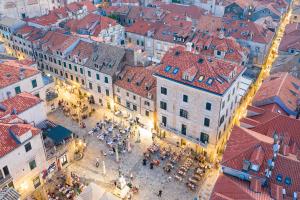 DubrovnikThe Pucic Palace