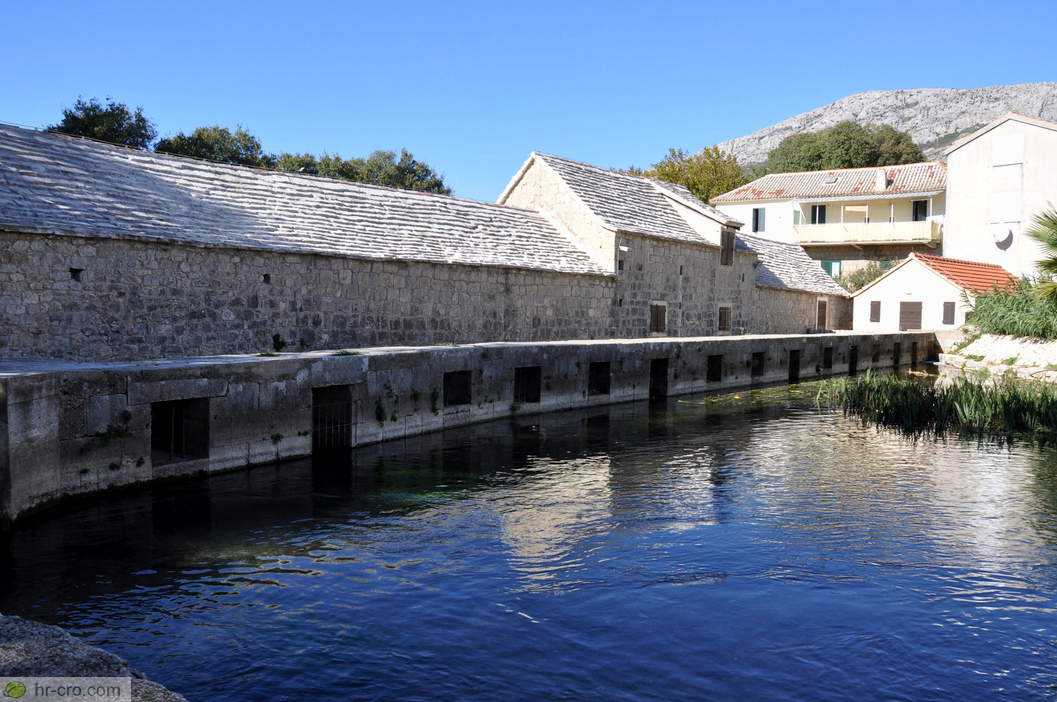
Built in the early 18th century, Gaspina Watermill (Gaspina mlinica) is one of the few preserved examples of traditional watermills in Croatia, located along the Jadro River in Solin. First mentioned in historical documents in 1711, the mill is an outstanding example of historic water-powered technology.
Its construction reflects a long tradition of watermill usage in the region, dating back to Roman times, when such mechanisms were vital for the agricultural economy and local communities. The watermill’s operation depended on the flow of the Jadro River, whose water powered the complex system of wooden gears, grinding stones, and other mechanisms. Farmers from the surrounding rural and coastal areas would bring their grain to be milled, creating a vital link between Solin and the broader Dalmatian hinterland. The milling process was an integral part of everyday life, as it provided essential food staples such as flour for bread and other goods. The mill also served as a gathering place, where people would meet, exchange news, and socialize while waiting for their turn. Over time, the Gaspina Watermill underwent various modifications to adapt to the needs of the local population. In the 19th century, significant renovations modernized the structure and improved its efficiency. However, with the advent of industrial milling in the mid-20th century, the watermill’s operations gradually ceased, leaving the building in a state of decline. Recognizing its cultural and historical value, the City of Solin, in cooperation with the Art Conservation Department of the Ministry of Culture, undertook an extensive restoration project in 2003. This effort preserved the mill’s unique architectural features and restored its mechanisms to working order, ensuring its survival as a cultural monument. Today, Gaspina Watermill is not only a protected cultural heritage site but also a significant tourist attraction that offers visitors an insight into the region’s rich history and traditions. The mill’s surroundings are equally significant, with the Jadro River often referred to as the “River of Life” for its importance to the development of Solin.
Visitors can explore the natural beauty of the area while learning about the historical relationship between water resources and early industries. For its historical, technical, and ethnographic significance, Gaspina Watermill is listed in the Register of Cultural Heritage of the Republic of Croatia, symbolizing the ingenuity and resilience of past generations.
 HR-CRO - Croatia
 SolinHotel President Solin