Umag is a coastal town located in the northwestern part of Istria in the Republic of Croatia. It lies on the Adriatic Sea, very close to the Slovenian border, and belongs to the Istria County, within the municipality of Umag. Today, the town is a popular tourist destination, combining a rich history, a Mediterranean atmosphere, and modern tourist facilities.
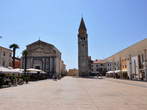
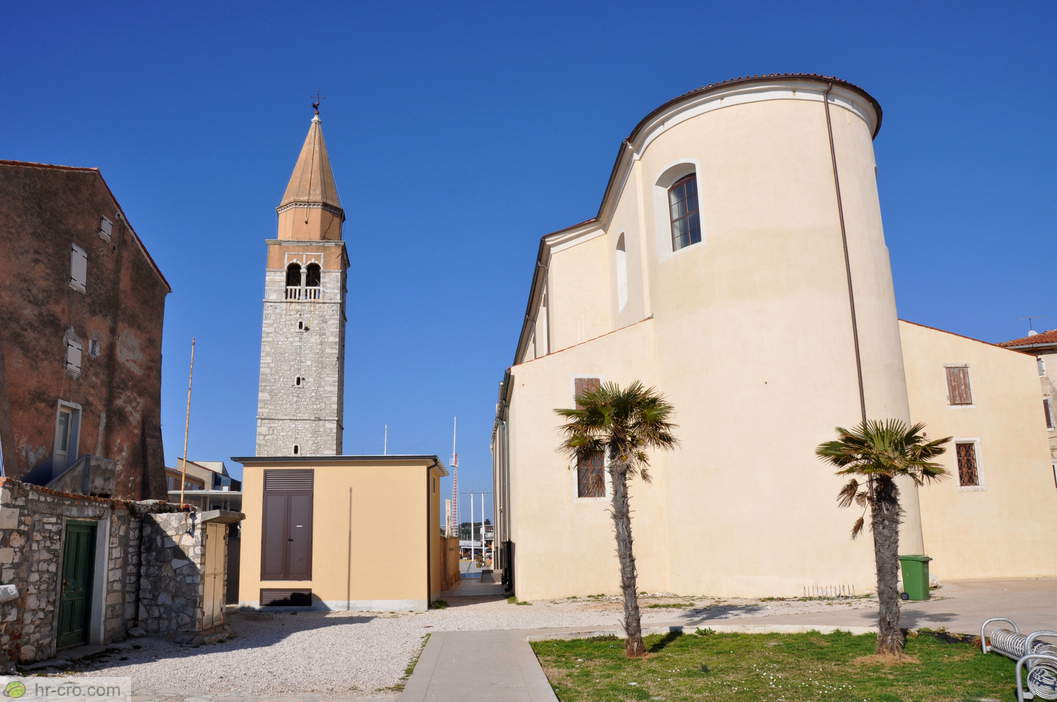
What is now a peninsula used to be an island, and the settlement developed at the far end of the former port of Umag. From early on, this area had strategic importance, which is why town walls with gates and a drawbridge were built in the 10th century. Parts of the fortifications have been preserved to this day, especially in the southwestern section near the Town Museum, which once formed part of the defensive system as one of the towers with a distinctive swallow-tail battlement, still visible from the sea. At the entrance to the old town stands the Church of St. Roch, built after the severe plague epidemics of 1507. Its interior features a remarkably preserved wooden ceiling painted in oil technique from the 18th century. The main religious building is the Parish Church of the Assumption of the Virgin Mary and St. Peregrine, the patron saint of Umag. It was designed by the architect Filippo Dongetti from Piran, although its Baroque facade was never completed. Inside, on the entrance wall, there is a built-in depiction of St. Peregrine from the 14th century, while the ceiling is decorated with a fresco attributed to Giuseppe Bernardino Bison. On the main altar stand statues of St. Peregrine and St. Nicephorus, and the church also contains valuable altarpieces and fragments of a wooden triptych from the 15th century. A particularly notable feature is the statue of Our Lady of Sorrows, attributed to the circle of followers of the Vivarini workshop. The church also houses organs dating from 1776. However, the most prominent architectural element is the bell tower, which rises 33 meters above the old town and dominates the skyline. Built in 1651, it is one of the most recognizable symbols of Umag. A Venetian lion was once placed on it, originally taken from the town hall that was destroyed in a fire in 1924. The bell tower, with its height and position, still defines the visual identity of the town, especially when seen from the sea. Behind the parish church there is also a public cistern dating from 1677, later restored. Near the church, a metal cannonball is embedded in the wall east of the apse. Historians believe it is a remnant of a cannon shot fired by a Genoese ship in 1810. The old town is characterized by narrow streets, stone houses with bifora windows, coats of arms, and inscriptions that reflect its rich past. On the facade of a house in Epifanio Street, a free early Christian sarcophagus from the 5th century is embedded. Many houses also feature pierced stone beams that were once used to hang and display embroidered fabrics, which helped protect the interiors from strong sunlight.
Along the coastline extends a breakwater, the construction of which began in 1825. It is approximately 400 meters long and today serves as a popular walking promenade. On St. Peregrine Beach stands the church of the same name, built in 1401 on the site where St. Peregrine is believed to have suffered martyrdom.
 HR-CRO - Croatia
 UmagCamping Stella Maris Mobile Homes