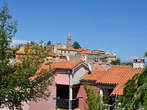
Labin is a town in eastern Istria with an older hilltop centre and newer districts below. In the historic quarter, noble homes, churches and public spaces developed close beside one another.
Among these houses,  1 May Street affords only brief views of individual façades.
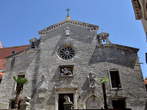
Scampicchio Palace stands beside the  Parish Church of the Nativity of the Blessed Virgin Mary. From the street, its restrained façade hides a more complex history of several connected buildings.
The palace was home to the prominent Labin family of Scampicchio. The 16th-century Renaissance complex includes an inner courtyard and a connection with the older town fabric. The family coat of arms survives on the façade.
Its connection with the neighbouring church is distinctive: after ceding land for the church's expansion, the family received permission for a private passage. This is not merely a picturesque feature above the street, but evidence of the close relationship between a noble home and the parish institution. The palace is therefore also worth viewing from the direction of the church.
According to an Istrian cultural heritage account, family members were associated with the town archive, which was kept in the palace. The building was thus both a residence and a place for records. From the street, its relationship to the church and open urban space is easiest to discern, while the inner courtyard belongs to a less visible part of the complex.
Together the palace and church show how little space separated different functions in old Labin. The passage above the street entered public space to provide a private route between home and worship. This contrast between the public street below and the family's connection above is its most revealing spatial feature.
 HR-CRO - Croatia
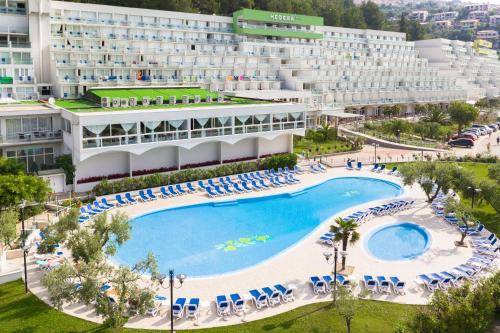 RabacHotel Hedera - Maslinica Hotels & Resorts