Labin is a historic town in eastern Istria; its older quarter occupies the hilltop above the lower districts. In the compact centre, former noble homes, churches and public buildings stand within short distances of one another.
In the upper old town,  1 May Street winds among large houses and churches. Their façades appear almost one after another along the narrow route.
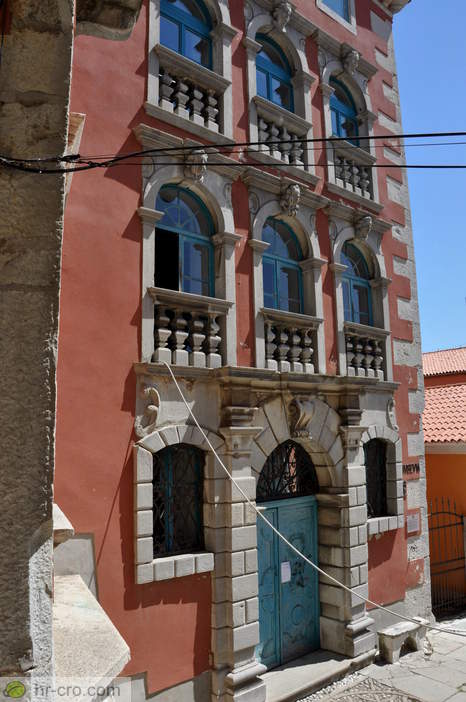
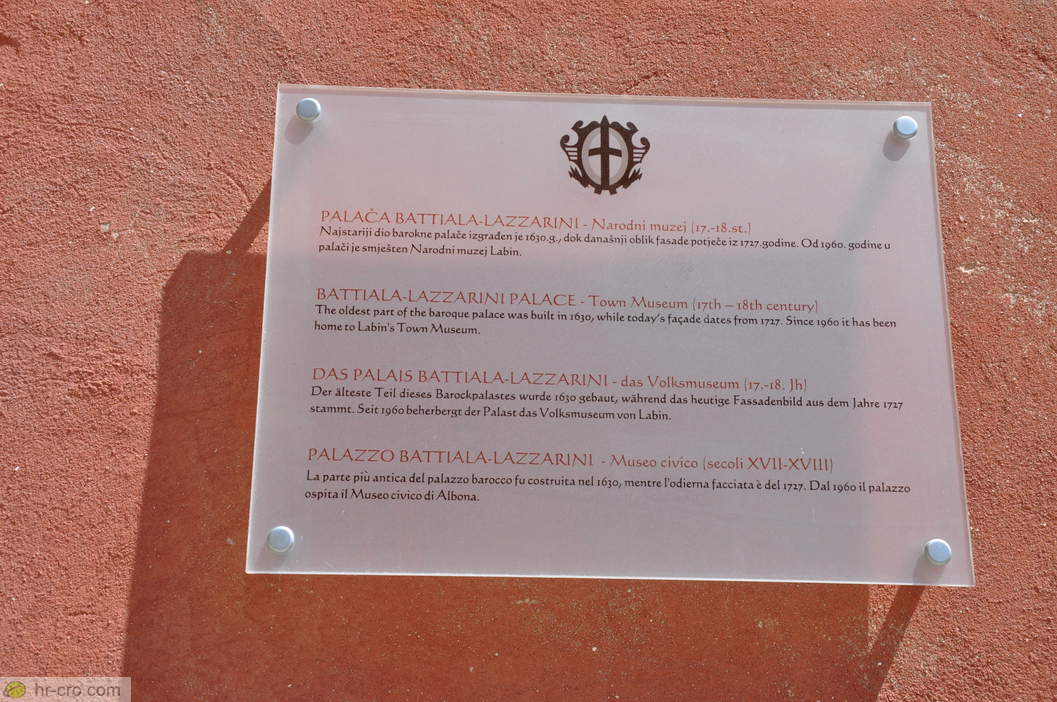
Battiala-Lazzarini Palace stands on this street, near the  parish church. Its red façade with white stone accents and blue doors is one of the most recognisable views in this part of town. The smaller
 Church of St. Stephen stands beside it.
The Battiala family began building the Baroque palace in the 17th century, and its distinctive façade took shape in the early 18th century. The Lazzarini family was later added to its name. The building occupies a substantial town block and includes the neighbouring Church of St. Stephen. Behind the prominent entrance is an atrium with a staircase leading to the principal first floor; the arrangement of the large hall and side rooms follows the Venetian palatial tradition.
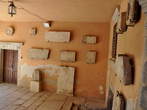
The Labin National Museum has occupied the palace since 1960. Its displays connect archaeological and urban heritage with the mining past of the Labin area; a reconstruction of a mine tunnel and its passages is particularly distinctive. A former noble residence thus became a place where the history of the old centre meets the history of work around the town. Much of the museum's presentation is devoted to mining, for which the region was long known.
The museum also explains the Labin Republic, a miners' self-government during the strike of 1921. The tunnel display conveys something of the working environment, while documents and objects tell the story of a community sustained by coal. The contrast between the imposing Baroque façade and the working-class subject matter inside is one of the features of the palace's present use.
After the Second World War, the last noble owners from the Lazzarini family left the palace. Its later museum use opened the building to the public without erasing its aristocratic architecture. Beside the steps and the neighbouring Church of St. Stephen, the red façade stands out sharply from the more restrained houses; a visit inside shows why this large town palace could become a place for the history of the whole Labin area.
 HR-CRO - Croatia
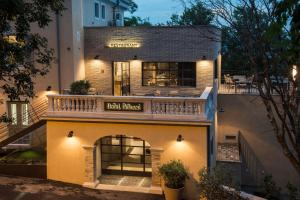 LabinHotel Peteani