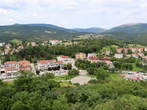
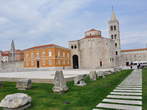
Buzet lies in northern inland Croatian Istria above the upper Mirna River valley. The town grew from prehistoric and Roman settlement into a medieval fortress, while Venetian rule strongly marked its present stone appearance. Visitors can read the town’s history directly in its portals, coats of arms, inscriptions and different layers of walling. Most of these layers are concentrated in the Old Town at the top of the hill.
Buzet's Old Town occupies an isolated hill above the Mirna valley in northern  Istria. Its medieval street plan, Venetian palaces, churches, cisterns and defensive edge form a compact stone town best explored on foot.
The main approach passes through  Vela Gate and beside the
 southern bastion. Inside stand the
 Parish Church of the Assumption of Mary, the separate
 bell tower,
 Bigatto Palace with the Regional Museum and the public
") Small Cistern and
") Great Cistern. Streets reach the northern edge at the
 Church of St George and the
") Small Gate.
The core extends from south to north along the hill. Two town gates, four squares and three principal streets form its characteristic plan, while the main square with the parish church was cut into the living rock.
The core is compact enough to explore on foot, but it should not be read as a list of isolated sights. Gates, walls, public cisterns, storehouses, palaces and churches together explain defence, supply, government and daily life in a fortified town. The published information map helps follow this spatial story.
 HR-CRO - Croatia
 BuzetBoutique Hotel Vela Vrata